

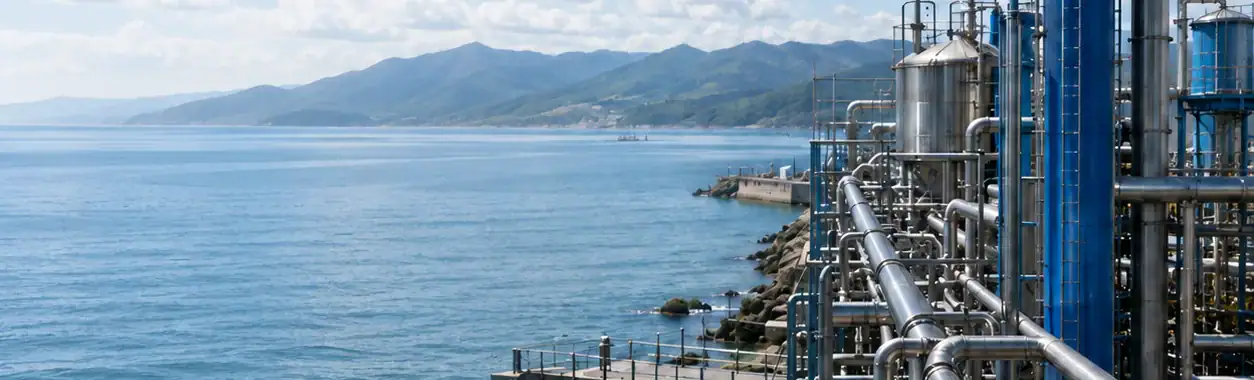
 When engineers and specifiers think about coastal corrosion, they often picture docks, shipyard cranes, tank farms, and waterfront infrastructure. The corrosion risk in these environments is well recognized. Ports, shipyards, coastal processing facilities, and other coastal and marine environments routinely encounter salt spray and airborne chlorides. That exposure makes corrosion resistance an important part of electrical system design and material selection.
However, chloride exposure does not stop at the shoreline. Relying mainly on distance from the coast can overlook site-specific conditions that influence corrosion risk. Wind can carry airborne chlorides inland, and several factors affect how much chloride reaches a facility. For conduit and fittings, engineers should consider actual site conditions, including the potential for chloride exposure inland.
Key Takeaway
Coastal corrosion risk does not end at a fixed distance from the water. Evaluating chloride exposure, moisture, and drainage at the site gives engineers a stronger basis for choosing between Type 304 and Type 316 stainless steel.
From Breaking Waves to Inland Sites
Marine aerosols form where wave action is most active. Breaking waves and surf trap air in the water, creating bubbles that rise and burst at the surface. Those bubbles release fine droplets into the atmosphere. Wind can also carry spray directly from wave crests, especially during higher sea states and storms. Together, these processes release chloride-bearing salt particles and droplets into the coastal atmosphere.
Once airborne, wind carries the particles inland while atmospheric turbulence disperses them. Some settle onto exposed surfaces, while precipitation removes others from the air. Depending on local conditions, chlorides can travel beyond the immediate shoreline before reaching electrical conduit, fittings, conduit bodies, and exposed metal surfaces. This movement of airborne chlorides shows why straight-line distance from the water provides only part of the corrosion-risk picture.
Distance from the Coast Is Only Part of the Corrosion Risk
Research in marine environments shows that chloride deposition generally decreases with distance from the sea. The decline, however, does not follow a uniform pattern. Chloride levels may fall sharply near the coast while lower and more variable concentrations continue farther inland.
As a result, two sites at the same distance from the water can experience very different deposition rates. Several site-specific factors influence chloride exposure beyond distance from the coast:

Prevailing wind direction affects how often onshore winds carry marine air toward a site.

Wind speed and storm activity influence how much marine aerosol forms and how far it travels inland.

Terrain and elevation affect how salt-laden air moves across a site and where it may concentrate.

Surrounding structures can shield portions of a facility or channel airflow toward specific areas and equipment.

Humidity and rainfall influence how long deposited salts remain before water dilutes or removes them.

Bays, inlets, and sounds can extend marine exposure farther inland than straight-line distance may suggest.

Two sites at the same distance from the water can see very different chloride exposure.
Because these variables interact differently at each site, no universal coastal mileage threshold applies to corrosion-risk assessment. Distance remains useful context, but it should not stand alone. Actual environmental conditions and areas where salts can accumulate also matter.
What Happens When Chlorides Reach the Surface
Chloride deposition alone does not determine corrosion risk. Moisture plays an equally important role after salts reach a metal surface. Chloride salts on a dry surface do not, by themselves, drive significant corrosion. This type of corrosion requires an electrolyte, or a film of moisture in which ions can move.
Certain chloride salts can absorb moisture from humid air even below the dew point. That behavior may keep a thin electrolyte layer on the surface longer than ambient humidity alone might suggest. Rain, condensation, washdown, and normal wet-dry cycling can introduce additional moisture. Together, moisture and chlorides can create conditions that promote localized corrosion.
Chloride ions can disrupt the protective films that many metals rely on for corrosion resistance. For that reason, chloride-containing environments often promote pitting corrosion and crevice corrosion rather than uniform surface loss. Geometry also plays a major role in crevice corrosion. Threaded connections, fitting interfaces, gasket contact areas, and narrow gaps can trap moisture and concentrate chlorides. Open, freely draining surfaces are less likely to retain those deposits.
Horizontal surfaces and areas with repeated condensation can also stay wet longer than vertical, well-drained surfaces. These conditions do not mean every chloride-exposed component will experience significant corrosion or failure. They show why chloride load, geometry, drainage, and duration of wetness should be evaluated together.
When Coastal Exposure Meets Industrial Conditions
Marine chloride exposure rarely acts alone at an industrial site. Facilities that encounter coastal aerosols may also face process chemicals, frequent washdown, elevated humidity, direct weather, and temperature cycling. These conditions often appear in chemical processing environments, wastewater treatment facilities, and other corrosive industrial settings.
The more useful engineering question is how the combined service environment affects long-term material performance. Moderate chloride deposition can become more demanding when frequent washdown and high humidity keep surfaces wet. A site closer to the water may present less exposure if conditions are drier and well ventilated.
Material selection should reflect the full exposure profile rather than one variable considered in isolation.
Where Stainless Steel Fits
Once engineers understand the site’s exposure conditions, they can make a more informed material choice. Stainless steel becomes an important consideration for electrical conduit and fittings in corrosive environments. Its corrosion resistance comes from a thin, chromium-rich oxide layer that forms naturally on the alloy’s surface. If handling or scratching disturbs that surface, the passive layer can reform when sufficient oxygen is available.
The alloy itself provides this corrosion resistance rather than an externally applied coating. That distinction matters in field conditions where installers cut, thread, handle, and assemble conduit and fittings.
Type 316 Stainless Steel
Type 316 stainless steel contains molybdenum in addition to chromium and nickel. Molybdenum improves resistance to localized corrosion, especially chloride-induced pitting and crevice corrosion. For this reason, engineers often consider Type 316 stainless steel conduit for marine and coastal applications. It is also widely used in wastewater, chemical processing, washdown areas, and other demanding environments.
Chloride concentration, moisture, temperature, geometry, and other conditions still affect performance. Even so, Type 316 generally offers greater resistance to chloride-induced localized corrosion than Type 304.
Type 304 stainless steel provides strong general corrosion resistance and may suit less aggressive service environments. Actual chloride exposure, moisture conditions, and other corrosive factors should determine whether it is the right fit.
Engineers should base the choice between Type 304 and 316 stainless steel on documented or reasonably estimated site conditions. A fixed mileage rule tied to the ocean does not provide the same level of information. Actual exposure conditions offer a stronger basis for material selection.
For a more detailed comparison, see What Is the Difference Between 304 and 316 Stainless Steel?
Type 304 vs. 316 Stainless Steel

Type 304
Strong general corrosion resistance for less aggressive service environments.

Type 316 Chloride Exposure
Contains molybdenum for greater resistance to chloride-induced pitting and crevice corrosion.
Evaluate Coastal Corrosion at the Site, Not Just on the Map
During specification, engineers should ask what the electrical system will encounter over its expected service life. That evaluation may include chloride deposition, prevailing winds, terrain, humidity cycles, nearby processes, washdown practices, drainage, and sustained wetness. Looking at those conditions together provides a stronger basis for material selection for electrical conduit in coastal environments.
For projects where coastal corrosion or other corrosive conditions are a concern, the complete service environment should guide material selection. Gibson Stainless manufactures stainless steel conduit and fittings in Type 316 and select Type 304 stainless steel. Selecting the appropriate grade starts with understanding the conditions the system will actually face.
Technical References
- Feliu, S., Morcillo, M., and Chico, B. Effect of Distance from Sea on Atmospheric Corrosion Rate. Corrosion, Vol. 55, No. 9, pp. 883–891, 1999. The study examines relationships among distance from the sea, marine aerosols, wind and surf conditions, chloride deposition, and atmospheric corrosion.
- Meira, G.R., Andrade, C., Alonso, C., Padaratz, I.J., and Borba, J.C. Modelling Sea-Salt Transport and Deposition in Marine Atmosphere Zone: A Tool for Corrosion Studies. Corrosion Science, Vol. 50, No. 9, pp. 2724–2731, 2008. The research examines marine aerosol transport and uses factors such as distance from the sea and wind speed to model sea-salt deposition.
- Nickel Institute. Design Guidelines for the Selection and Use of Stainless Steels, Publication No. 9014. This technical guide provides information for designers and specifiers on stainless steel selection, corrosion resistance, and material performance.